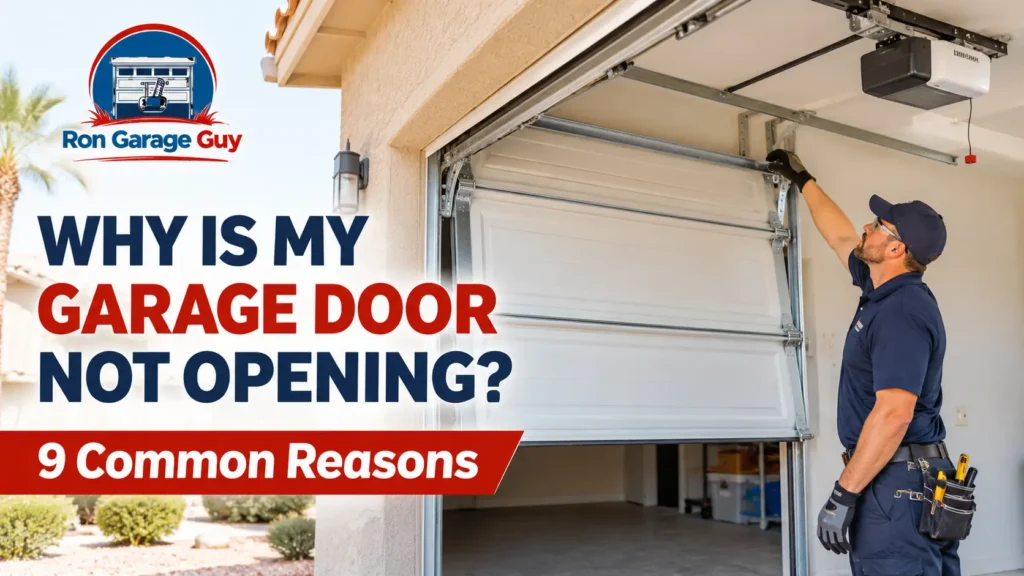
Pressing your garage door remote and getting no response can be frustrating, especially when you need to leave home or access your vehicle. Sometimes the issue is as simple as a dead remote battery. In other situations, a broken spring, damaged cable, faulty opener, or misaligned track may prevent the door from moving.
A garage door system contains several connected components that must work together for smooth and reliable operation. When one part fails, the entire system may stop functioning.
If your garage door is not opening, identifying the possible cause can help you understand what needs attention and whether professional repair is necessary.
For homeowners in Surprise, Peoria, Sun City, and surrounding Arizona communities, here are nine common reasons a garage door may refuse to open.
1. Dead Garage Door Remote Batteries
One of the simplest reasons a garage door will not open is a dead or weak remote battery.
If the remote stops communicating with the garage door opener, pressing its button may produce no response. You may notice that the wall-mounted control still works even though the handheld remote does not.
Common signs include:
- The remote light does not turn on.
- The garage door responds inconsistently.
- The wall control operates the door normally.
- The remote works only when held very close to the opener.
What you can do:
Replace the remote batteries with the correct type recommended by the manufacturer. Check the battery orientation and make sure the contacts are clean.
If a new battery does not solve the problem, the remote may need reprogramming or replacement. There could also be an issue with the opener’s receiver.
2. Garage Door Opener Has Lost Power
Your garage door opener needs a reliable power supply to operate. If the motor unit is not receiving electricity, it will not respond to remote commands or wall controls.
Power-related problems may occur because of:
- An unplugged opener
- A tripped circuit breaker
- A disconnected power supply
- A damaged electrical outlet
- A temporary power interruption
What you can do:
Check whether the opener is plugged into its outlet. If the outlet is accessible and safe to inspect, verify that it has power. You can also check your home’s electrical panel for a tripped breaker.
Do not open electrical components or attempt wiring repairs yourself. If the outlet has power but the opener remains unresponsive, the motor unit or its electrical components may need professional inspection.
For persistent opener problems, consider professional garage door opener repair.
3. Broken Garage Door Springs
Garage door springs help counterbalance the weight of the door, allowing it to open and close without placing excessive strain on the opener.
When a spring breaks, the door may become extremely heavy. The opener may struggle to lift it, stop moving, or refuse to operate.
Warning signs of a broken spring include:
- A loud bang from the garage
- A visible gap in a torsion spring
- A garage door that only opens a few inches
- A door that appears unusually heavy
- A crooked or uneven door
- An opener that strains without lifting the door
Trying to operate a garage door with a broken spring can cause additional damage.
What you should do:
Stop using the opener and keep people away from the door. Do not attempt to lift the door manually or adjust the spring yourself.
Spring systems are under significant tension and can cause serious injuries. Contact a trained technician for inspection and garage door spring replacement.
4. Garage Door Safety Sensors Are Blocked or Misaligned
Modern garage doors use safety sensors near the bottom of the tracks to detect objects in the door’s path.
If the sensors are blocked, dirty, misaligned, or damaged, the opener may prevent the door from closing properly or reverse its movement.
Although sensor problems more commonly affect closing, some opener systems may also behave unexpectedly when a sensor or its wiring is faulty.
Common warning signs include:
- The opener light flashes.
- The door starts closing and then reverses.
- One or both sensor indicator lights are off or blinking.
- The door operates inconsistently.
- The sensor lenses appear dusty or obstructed.
What you can do:
Check whether objects are blocking the sensors. Remove visible dust from the sensor lenses using a soft, dry cloth. Make sure the sensor brackets have not been knocked out of position.
Never bypass or disable the safety sensors to force the door to operate. If the sensors remain unresponsive, a technician can inspect their alignment, wiring, and operation.
5. Garage Door Tracks Are Bent or Misaligned
Garage door tracks guide the rollers as the door moves. If a track becomes bent, loose, or misaligned, the door may become stuck or move unevenly.
Track problems can develop because of accidental impacts, worn mounting hardware, or repeated mechanical stress.
Signs of track damage include:
- Grinding or scraping noises
- Visible bends in the metal track
- Rollers struggling to move
- A door that stops partway
- Uneven gaps between the door and frame
- A door that appears crooked
What you can do:
Look at the visible track sections for obvious damage or obstructions. Avoid forcing the door to move if the rollers appear out of position.
Bent tracks and alignment problems require proper inspection and adjustment. For damaged or misaligned tracks, professional garage door track repair may be necessary.
6. Garage Door Cables Are Broken or Damaged
Garage door cables work with the spring system to support controlled door movement.
If a cable becomes frayed, loose, or breaks, the door may become uneven or fail to open properly. In some situations, one side of the door may drop lower than the other.
Look for these warning signs:
- A visible broken or hanging cable
- A crooked garage door
- Uneven movement during operation
- The door becoming stuck
- Loose cable sections near the drums
What you should do:
Stop operating the garage door if you suspect cable damage. Do not touch, pull, or attempt to reposition the cables.
Damaged cables can create dangerous tension-related hazards. A qualified technician can inspect the cable system and determine whether garage door cable replacement is required.
7. Garage Door Is Locked or the Manual Lock Is Engaged
Some garage doors have manual locking mechanisms that prevent the door from opening.
If the lock is engaged, the opener may struggle against the door or fail to lift it.
This can happen when someone accidentally activates the lock or when a manual locking mechanism is not fully disengaged.
Common signs include:
- The opener motor runs but the door does not move.
- The door feels secured in place.
- The manual lock is visibly engaged.
- The opener strains during operation.
What you can do:
If your door has a manual lock, check its position and consult the manufacturer’s instructions. Do not force the opener to lift a locked door.
If the lock appears damaged, jammed, or difficult to disengage, arrange a professional inspection.
8. Garage Door Opener Gear or Motor Problems
The garage door opener contains mechanical and electrical components that control door movement. Over time, gears, drive systems, and motors can wear out or fail.
A damaged opener may make noise without moving the door, operate intermittently, or stop responding completely.
Signs of opener problems include:
- The motor runs but the door does not move.
- The opener makes grinding or unusual noises.
- The door stops before reaching its full position.
- The remote and wall control both fail.
- The opener operates inconsistently.
The problem may involve worn internal gears, a damaged drive mechanism, faulty wiring, or motor failure.
What you can do:
Check the opener’s indicator lights and consult its manual for any displayed error codes. Avoid opening the motor housing or attempting internal electrical repairs.
A technician can diagnose the problem and determine whether a repair or replacement is appropriate. If the opener cannot be repaired reliably, a new garage door opener installation may be recommended.
9. Garage Door Is Out of Balance or Has a Mechanical Obstruction
A garage door must remain properly balanced to operate smoothly. If the counterbalance system is not working correctly, the opener may struggle to lift the door.
Obstructions can also prevent normal movement. Objects near the tracks, damaged rollers, or debris around moving components may interfere with operation.
Possible warning signs include:
- The door moves unevenly.
- The opener struggles to lift the door.
- The door stops at the same point repeatedly.
- Unusual noises occur during movement.
- The door appears heavier than normal.
What you can do:
Check the visible opening area for objects or debris that may be obstructing movement. Do not attempt to adjust the springs or disconnect the opener to test the door’s balance without professional guidance.
If the door remains difficult to operate, arrange an inspection to identify whether the issue involves the spring system, rollers, tracks, or another mechanical component.
What Should You Do When Your Garage Door Will Not Open?
If your garage door suddenly stops working, avoid repeatedly pressing the remote or forcing the door to move.
Start with a few basic checks:
- Check the remote: Replace weak batteries and test the remote again.
- Check the power supply: Make sure the opener is plugged in and receiving power.
- Inspect the safety sensors: Look for visible obstructions or dust.
- Check the manual lock: Make sure it is not engaged.
- Look for visible damage: Check for broken springs, loose cables, bent tracks, or crooked door movement.
- Stop if something looks damaged: Do not continue operating a door with a suspected spring, cable, or track problem.
- Contact a professional: Arrange an inspection if the cause is not obvious or the door remains stuck.
These basic checks may help identify simple issues, but mechanical and electrical repairs should be handled by qualified technicians.
Why You Should Not Force a Stuck Garage Door
Trying to force a garage door open can make an existing problem worse.
For example, an opener may continue applying force even when a broken spring or damaged track prevents normal movement. This can increase strain on the opener and other components.
Forcing a damaged door may also lead to:
- Additional cable damage
- Bent or damaged tracks
- Roller displacement
- Opener mechanism failure
- Sudden door movement
- Serious injury
If the door appears crooked, has a broken spring, or has a loose cable, keep people away and contact a professional.
When Should You Call a Garage Door Repair Technician?
Some garage door problems are simple enough to identify through basic troubleshooting. Others require professional tools, experience, and safety procedures.
You should arrange professional repair if:
- The garage door has a broken spring.
- A cable is frayed or hanging loose.
- The door has come off its tracks.
- The opener motor runs but cannot lift the door.
- The door moves unevenly.
- Safety sensors do not work correctly.
- The door repeatedly gets stuck.
- You cannot identify the source of the problem.
A technician can inspect the entire system, identify the underlying cause, and recommend the appropriate repair instead of replacing parts unnecessarily.
Ron Garage Door LLC provides garage door repair and maintenance services for homeowners in Surprise, AZ, and nearby communities.
How Regular Garage Door Maintenance Can Prevent Opening Problems
Many garage door issues develop gradually. Worn rollers, loose hardware, damaged seals, and insufficient lubrication can affect normal operation over time.
Routine maintenance helps identify these problems before they lead to a complete breakdown.
A professional inspection may include:
- Checking springs and cables for visible wear
- Inspecting rollers and hinges
- Examining track alignment
- Lubricating compatible moving components
- Testing the garage door opener
- Inspecting safety sensors
- Checking weather seals
- Evaluating overall door operation
Homeowners can learn more about garage door maintenance and the benefits of routine inspections.
A professional garage door tune-up can also help identify developing mechanical issues and support reliable operation.
Garage Door Repair in Surprise, AZ, and Nearby Areas
A garage door that will not open can disrupt your daily routine and create access or security concerns.
Whether the problem involves a faulty opener, broken spring, damaged cable, or misaligned track, identifying the underlying cause is the first step toward getting the system working again.
Ron Garage Door LLC provides garage door services for homeowners in:
- Surprise, AZ
- Peoria, AZ
- Sun City, AZ
- Phoenix, AZ
- Glendale, AZ
- El Mirage, AZ
- Goodyear, AZ
- Avondale, AZ
If your garage door is stuck or refusing to open, contact Ron Garage Door LLC to discuss the problem and arrange appropriate service.
Frequently Asked Questions
Why is my garage door not opening but the motor is running?
If the motor runs but the door does not move, the issue may involve a disconnected drive mechanism, worn opener gears, a broken spring, or another mechanical problem. Stop operating the door and arrange an inspection.
Why won’t my garage door open with the remote?
A dead remote battery, programming issue, signal interference, or faulty receiver can prevent the remote from communicating with the opener. Replace the batteries first. If the wall control works but the remote does not, the issue may be limited to the remote or its signal.
Why is my garage door stuck halfway?
A garage door may stop halfway because of a broken spring, damaged track, worn rollers, an obstruction, or an opener problem. Avoid forcing it to move until the cause has been identified.
Can a broken garage door spring prevent the door from opening?
Yes. Garage door springs counterbalance the door’s weight. When a spring breaks, the opener may be unable to lift the door safely.
Why does my garage door make noise but not open?
Unusual noises without normal movement may indicate worn opener gears, a broken spring, damaged rollers, a disconnected drive mechanism, or track problems. The system should be inspected before further operation.
Can I open my garage door manually during a power outage?
Many garage doors have an emergency release mechanism that allows manual operation during a power outage. However, only use it if the door is closed, appears undamaged, and you can follow the manufacturer’s instructions safely. Never attempt to manually lift a door with a suspected broken spring or cable.
How much does it cost to repair a garage door that will not open?
The cost depends on the cause of the problem, the parts involved, and the amount of labor required. A remote battery issue may be inexpensive, while spring, cable, track, or opener repairs can involve more extensive work. Request an inspection and estimate before approving repairs.
When should I replace my garage door opener instead of repairing it?
Replacement may be worth considering when the opener has major internal damage, repeated failures, unavailable replacement parts, or an outdated safety system. A technician can assess whether repair or replacement makes more sense.
Get Your Garage Door Working Again
A garage door that will not open can result from several problems, ranging from simple remote issues to serious mechanical failures.
Checking the batteries, power supply, and visible obstructions can help identify basic issues. However, broken springs, damaged cables, bent tracks, and opener failures require proper inspection and repair.
If your garage door is stuck, making unusual noises, or refusing to respond, Ron Garage Door LLC can help identify the problem and recommend an appropriate solution.
Need garage door repair in Surprise, AZ?
Visit Ron Garage Door LLC to learn more about available garage door services.